
Steam Iron
A steam iron is a heated pressing tool that applies both heat and steam directly to felt during the hat-making process. Unlike a garment steamer, which softens felt using steam alone, a steam iron combines a heated soleplate with steam to provide controlled contact with the material. This combination allows the hatter to influence the condition and surface characteristics of the felt while maintaining precise control over the area being worked.
Steam irons have been used in both factory production and custom hat making for many decades and remain an important piece of equipment in many modern workshops. Depending on the design, a steam iron may generate its own steam from an internal reservoir or receive steam from an external boiler system. The choice of equipment often depends on the workshop’s production volume, preferred working methods, and available steam source.
Steam Irons in Hat Making
Steam irons occupy a distinct role within the hat-making workshop by combining controlled heat with the application of steam through direct contact with the felt. This capability allows the hatter to work on localized areas of a hat while maintaining greater precision than is typically possible with free-flowing steam alone. Throughout the history of felt hat production, steam irons have been used wherever controlled heat and moisture are required to influence the condition of the felt.
The use of steam irons spans both industrial and custom hat making. Large manufacturing facilities often incorporated gravity-fed or boiler-supplied irons into production lines, while smaller custom workshops have employed compact steam irons or modified household irons depending on the scale of their operations. Regardless of the equipment chosen, the underlying purpose has remained consistent: to provide a controlled means of applying heat and moisture directly to the material.
Unlike stand-alone steamers, which primarily soften felt by surrounding it with steam, a steam iron introduces a heated pressing surface that can influence the felt in a more localized manner. As a result, steam irons are often regarded as complementary tools rather than replacements for traditional steamers. Many workshops employ both forms of equipment, selecting the most appropriate tool according to the operation being performed.
Characteristics of an Effective Steam Iron
The suitability of a steam iron for hat making is determined less by its appearance than by its ability to deliver consistent heat, dependable steam, and precise control. Because felt responds to variations in temperature and moisture, the stability of the equipment is often more important than its maximum output. An iron that maintains predictable operating conditions allows the hatter to work with greater consistency across a wide variety of felt weights and finishes.
The design of the soleplate is another important consideration. Its size, shape, and surface characteristics influence the areas of a hat that can be reached comfortably and the degree of control that can be maintained during use. Different workshops have historically favored different soleplate designs depending on the types of hats produced and the methods employed.
The method by which steam is supplied also affects an iron’s suitability. Some irons contain an internal water reservoir and generate steam independently, while others receive steam from an external boiler or gravity-fed system. External steam systems generally provide a continuous supply of steam suitable for extended workshop use, whereas self-contained irons offer greater portability and simplicity for smaller operations.
Reliability, serviceability, and long-term durability have also contributed to the reputation of many professional steam irons. Because these tools are often expected to perform repeatedly over many years, commercial workshop equipment has traditionally emphasized robust construction and components designed for maintenance rather than replacement.
Types of Steam Irons
Steam irons used in hat making can be broadly categorized according to the method by which they generate or receive steam. Although the fundamental purpose of each type remains the same, their design reflects the differing needs of home workshops, custom hatters, and commercial production facilities.
Self-contained steam irons incorporate an internal water reservoir and heating element that generate steam within the iron itself. These units are widely available, require minimal supporting equipment, and are often suitable for smaller workshops or occasional use. Their simplicity has made them a common entry point for many hat makers.
Gravity-fed steam irons receive water from an elevated reservoir positioned above the iron. Water flows to the heated soleplate by gravity, providing a longer operating period than most self-contained irons while reducing the need for frequent refilling. This design became popular in commercial sewing, tailoring, and millinery shops where continuous operation was desirable without the complexity of a boiler system.
Boiler-supplied steam irons obtain pressurized steam from a separate steam generator. The iron itself contains little or no water, serving primarily as the means of directing heat and steam to the workpiece. These systems are commonly found in professional workshops and industrial settings where sustained steam production, rapid recovery, and extended operating periods are important.
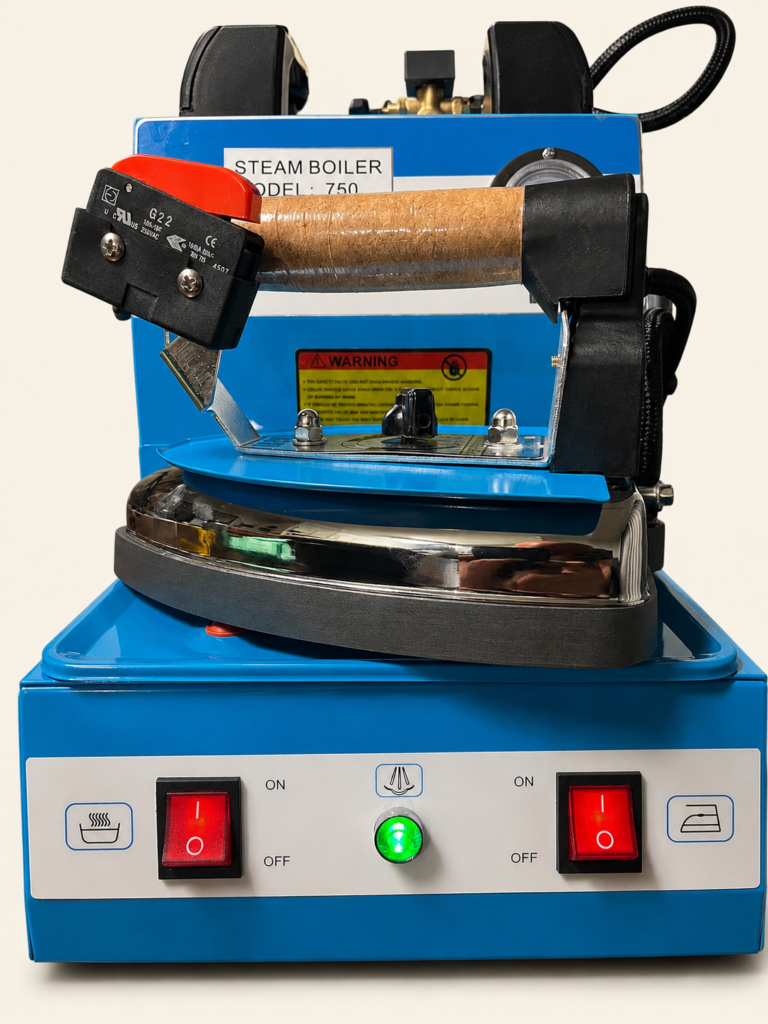
Technical Reference: ST-750 Steam Boiler Iron
The Workshop Ledger maintains a detailed technical reference for an ST-750 steam boiler iron based on direct ownership, examination, component identification, measurements, operating observations, and controlled testing.
View the ST-750 Steam Boiler Iron Technical Reference →
Throughout the twentieth century, manufacturers produced numerous commercial steam irons intended for tailoring, garment manufacturing, and millinery. Many of these machines continue to find use in modern hat workshops because of their durability, serviceability, and reliable performance. Historically significant manufacturers and individual models are best documented through dedicated reference articles, allowing general discussions of steam irons to remain focused on the broader subject.
Historical Development
The use of heated irons in the manufacture of hats predates the development of modern steam-generating equipment. Early hatters relied upon solid irons heated by external sources to apply pressure and heat during various stages of production. As steam became more widely available in industrial workshops during the nineteenth century, manufacturers began combining heated soleplates with steam delivery systems, creating tools capable of applying both heat and moisture in a single operation.
The growth of factory hat production during the late nineteenth and early twentieth centuries accelerated the adoption of steam irons designed for continuous commercial use. Many of these irons shared technology with the tailoring, garment, and millinery trades, reflecting the close relationship between industries that depended upon the controlled pressing and shaping of textile and felt materials. Boiler-fed and gravity-fed systems became common in larger workshops where reliability and uninterrupted operation were essential.
As electrical appliances became increasingly common throughout the twentieth century, self-contained steam irons provided smaller workshops with a practical alternative to centralized steam systems. While these consumer-oriented designs offered greater convenience, many professional hat makers continued to favor commercial equipment because of its durability, consistent steam delivery, and ability to withstand prolonged daily use.
Today, modern hat workshops employ a wide range of steam irons, from household appliances adapted for occasional use to industrial systems originally designed for commercial pressing operations. Although the technology has evolved, the fundamental purpose of the steam iron within the craft has remained remarkably consistent: to provide the hatter with a controlled means of applying heat and steam directly to felt.
Related Topics
Related topics include steamers, steam funnels, boiler systems, gravity-fed steam systems, hat blocks, band blocks, brim flanges, felt bodies, brim shaping, crown shaping, and hat restoration.
Selected References
The information presented in this article has been synthesized from historical publications, professional hat-making sources, surviving workshop equipment, and original research conducted by The Workshop Ledger. Ongoing investigation of historical steam-generating equipment, pressing systems, and traditional workshop practice continues to refine and expand the understanding of steam irons and their role within felt hat making.
Principal sources informing this article include historical trade literature concerning steam pressing equipment, original research maintained within The Workshop Ledger Research Library regarding steam irons, gravity-fed systems, boiler-supplied irons, and commercial pressing equipment, together with observations of professional workshop practice documented by Hornskov Hat Works. Research into historical steam-pressing equipment, including the 1880 United States Patent US232716A, Milliner’s Steamer and Presser, has also informed the historical development and evolution of steam-assisted pressing systems discussed in this article. As additional primary sources—including historical trade catalogs, manufacturer literature, patents, and workshop manuals—are identified and verified, they will be incorporated into future revisions.