About The Workshop Ledger
Learning the Craft. Preserving the Knowledge.
The Workshop Ledger began as the record of my journey into traditional hat making — from a lifelong appreciation for hats to learning how a fur-felt hat is made from the raw body up.
Along the way, it became something more: a custom felt hat company and a place to document the tools, materials, techniques, equipment, and history surrounding a craft whose knowledge is often difficult to find and, in some cases, in danger of disappearing.
I am not a master hatter. I’m still learning the craft.
The Workshop Ledger documents that process as it happens while putting that growing knowledge into practice — making hats, restoring and reshaping vintage hats, studying traditional tools and techniques, and preserving what I learn along the way.
A Lifelong Affinity for Hats
I’ve always had an affinity for hats, particularly those that were a little different from the average ball cap.
I bought my first real felt hat when I was sixteen: a black Resistol Westerner with a telescope crown. I chose it largely because it reminded me of my favorite Western star, Clint Eastwood. I still own that hat today.
Over the years, my tastes wandered through Panama hats, fedoras, flat caps, and eventually pork pies.
For many years, one of my favorites was a dark red wool pork pie I bought around 2010 from Meyer the Hatter in New Orleans. I loved the proportions — the short crown and stingy brim — and found myself continually looking for other pork pies.
There were plenty of inexpensive hats for sale online, but they rarely appealed to me. I wanted something made from good materials, with the character and proportions I was looking for — something that looked and felt like it would last.
That search eventually led me backwards instead of forward: to vintage hats, and eventually to the craft of making them.
Discovering the Craft
As I searched for vintage hats, the algorithms began putting the work of contemporary hat makers in front of me.
I was immediately fascinated.
A quality fur felt hat turned out to be much more complicated than I had imagined. There were different felts and different grades of felt. Hat blocks and flanges. Steamers and puller-downers. Conformateurs and Formillions. Sweatbands and liners. Grosgrain and Petersham ribbon.
Even the shape of a person’s head mattered.
The more I learned, the more I wanted to understand.
Eventually, a thought began to take hold:
I think I can do this.
So I started researching what it would actually take. I found communities of hat makers willing to answer questions, began acquiring and studying traditional tools, examined vintage hats, and started experimenting with the techniques I was learning.
What began as curiosity gradually became a serious pursuit of the craft. I began building a working hat shop, seeking out experienced hat makers willing to share their knowledge, and preparing for hands-on training in traditional hat making.
The First Hat I Made My Own
My first substantial hands-on project wasn’t a hat made from a raw body.
It was a vintage Dobbs fedora.
I steamed the hat, opened the old crown, and reshaped it into the style I had spent years searching for: a pork pie.
And I loved the process.
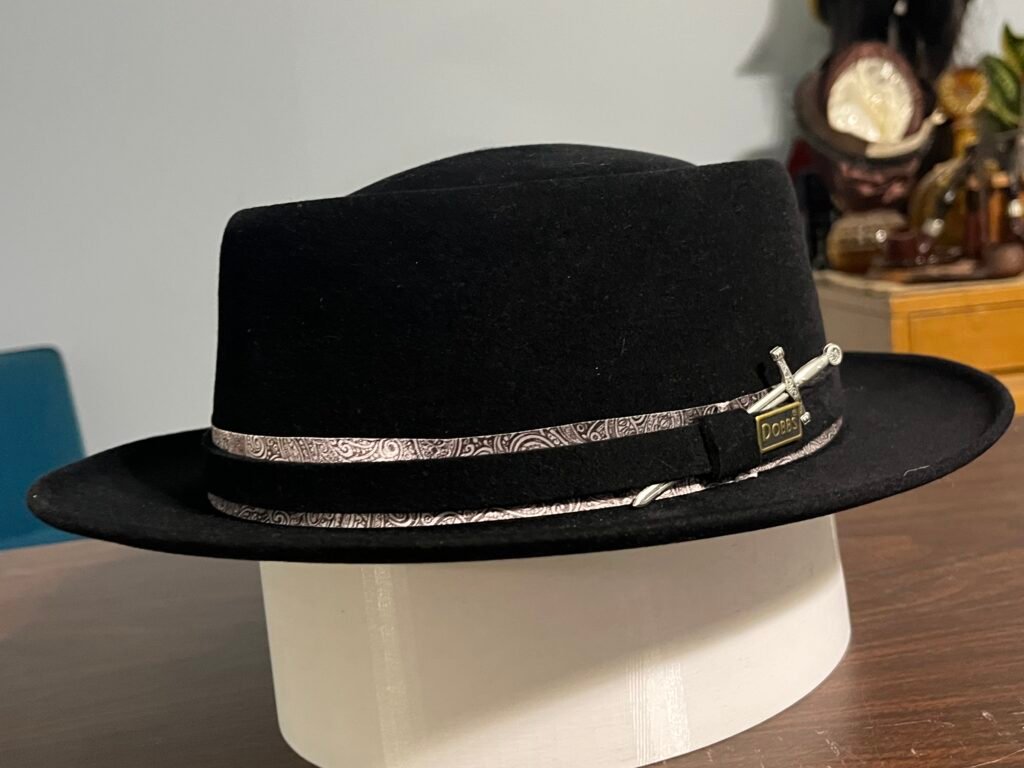
There was something deeply satisfying about taking an existing piece of felt and changing its proportions and character with steam, tools, and my own hands. It was the point at which an interest in hats began turning into an interest in making hats.
But the finished Dobbs also taught me something important.
It fit.
But it didn’t fit perfectly.
Fit Changes Everything
A hat size is only part of the equation.
Two people can have approximately the same head circumference and still have differently shaped heads. A truly custom hat needs to account for both size and shape.
That distinction has become one of the things that interests me most about traditional hat making.
It also changed my goal.
I don’t simply want to reshape existing hats. I want to learn the entire process: beginning with a raw fur felt hat body and finishing with a complete hat shaped and fitted specifically to the person who will wear it.
That goal has since grown beyond making hats for myself. The Workshop Ledger is being built around making individually commissioned fur-felt hats, fitted and finished for the person who will wear them.
Learning that complete process — and continuing to improve it — remains at the center of what I’m doing.
Why The Workshop Ledger Exists
Learning this craft quickly exposed another problem: the information exists, but it is scattered everywhere.
Some of it survives in old books and catalogs. Some exists in manufacturer literature. Some lives in online communities. Some is passed directly from one hat maker to another. And some can only be learned by examining the old tools and machines themselves.
Occasionally, different sources even contradict one another.
So I began keeping records.
That idea eventually became The Workshop Ledger.
A ledger is a continuing record, and that is how I think of this site. It isn’t intended to present my current knowledge as the final word on hat making. It records what I learn, where the information came from, what I observe firsthand, what I try in the workshop, and — just as importantly — what turns out not to work.
As my understanding improves, the ledger should improve with it.
Preserving What We Can
The deeper I get into traditional hat making, the more interested I become in the traditions behind it.
That appreciation for tradition isn’t entirely new to me. Before hat making, I spent eight years studying martial arts, eventually earning a second-degree black belt and becoming a certified instructor. Although I have since retired from martial arts, those years gave me a lasting respect for what it means to become part of a long-standing art form.
You learn from people who learned from people before them. Techniques have histories. Teachers have teachers. Lineages develop. Knowledge is passed down, adapted, and sometimes lost.
As I’ve gone deeper into hat making, I’ve found myself recognizing many of those same ideas.
Hat makers have their own lineages. Techniques and working methods pass from one maker to another. Specialized terminology that seems obscure to an outsider carries generations of practical knowledge. Tools were developed for particular jobs, and understanding how and why they were used is part of understanding the craft itself.
Much of that knowledge is still alive and being generously shared by working hat makers. But some of it is becoming harder to find. Manufacturers disappear. Vintage equipment survives without manuals. Specialized machines are misidentified or discarded. Experienced craftspeople retire, and knowledge that was once commonplace can become difficult to reconstruct.
That makes preservation more than an academic exercise to me.
A craft is more than the finished object. It is also the knowledge, tools, techniques, and traditions that make the object possible.
When I encounter something worth preserving, I want The Workshop Ledger to record it as well as I can — through original literature, photographs, measurements, firsthand examination, parts identification, experiments, operating observations, and corrections when new information comes to light.
I won’t be the origin of most of this knowledge. In many cases, I’ll simply be one more person in the chain through which it passes.
And that’s exactly why I think it’s worth preserving.
What’s in the Ledger
The Workshop Ledger is being built around several interconnected areas of traditional hat making: Hat Making & Construction, Tools & Equipment, Materials, Restoration & Renovation, and History & Reference.
Alongside the Ledger is the custom hat side of the workshop, where individually commissioned fur-felt hats are designed and made using the same traditional tools, materials, and techniques explored throughout the site.
Some entries are straightforward reference pages. Others document projects taking place in the workshop. More complicated equipment may receive full technical references and downloadable manuals that can be revised as additional information becomes available.
You will also find mistakes, experiments, unanswered questions, and pages that change over time.
That’s intentional.
The Journey Continues
The goal at the heart of this journey is still simple to describe, even if mastering it isn’t:
Take a raw fur felt body and turn it into a finished hat, made by hand and fitted precisely to the size and shape of the person who will wear it.
That remains the foundation. But The Workshop Ledger has grown around it — into a working hat shop, a custom felt hat company in Baton Rouge, Louisiana, and a continuing record of the craft I’m learning and the knowledge I hope to help preserve.
There will always be more to learn, better work to do, and more of the craft worth documenting.
The Workshop Ledger continues.